Applied AI / 03
governed self-service
Analytics copilot
Ask the warehouse a question in plain English and get governed SQL, a chart and a one-line answer, or an honest decline.
The decisionWhether a business user can get a trustworthy number without waiting for an analyst.
01 / Overview
The problem, and the approach.
AThe challenge
Self-service analytics fails in two ways: people cannot get the number without an analyst, or an AI tool hands them a confident number computed the wrong way. The second failure is worse, because nobody notices.
BThe approach
A semantic layer of nine governed metrics, each with one definition and an owner. A plain-English question is parsed into a metric, filters and a breakdown, compiled to SQL against a read-only warehouse, and returned with a chart, a one-line answer and the SQL itself. Anything outside the layer is declined. Claude can be switched on for parsing; the rule-based parser is the default, and both are measured on the same test sets.
02 / The decision journey
5 decisions, one story.
Each stage asks one business question and answers it with a model you can open and change. Any card opens that stage of the live demo.
-
 01
Ask
What do you want to know?
Plain English in; governed SQL, a chart and a one-line answer out.
Open this stage
01
Ask
What do you want to know?
Plain English in; governed SQL, a chart and a one-line answer out.
Open this stage
-
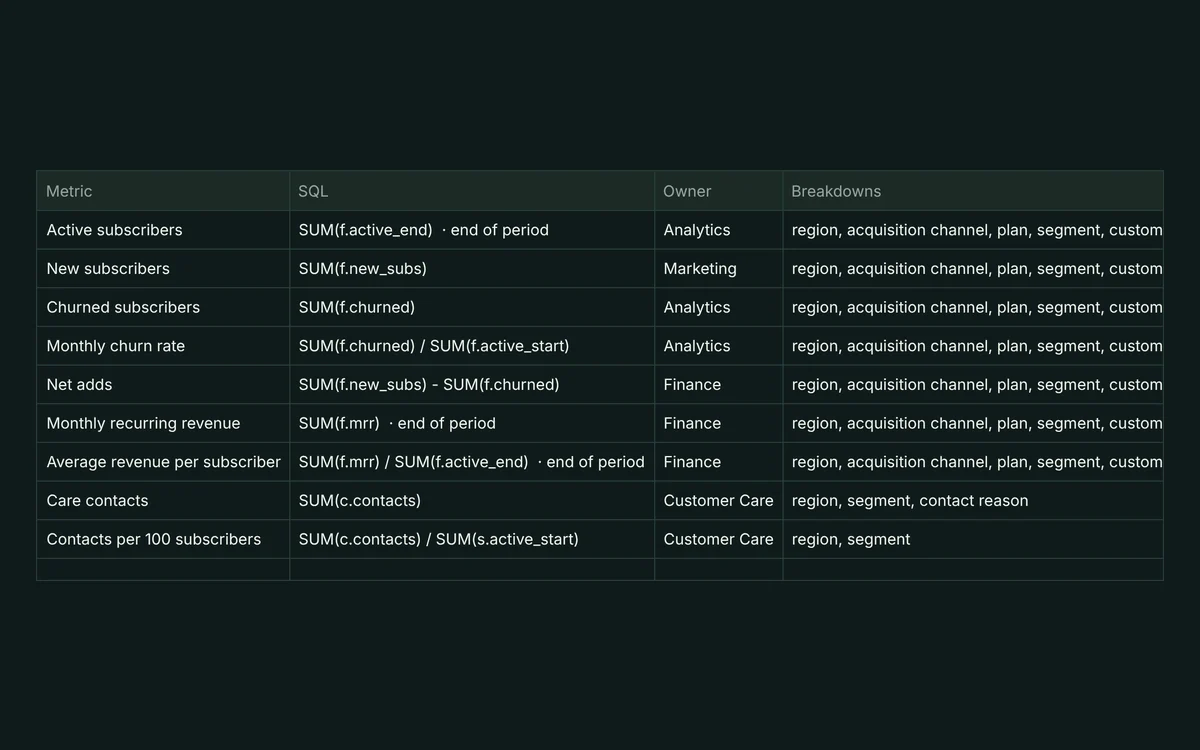 02
Define
What does each number mean, exactly?
Nine metrics with owners; snapshots and ratios handled once, in the layer.
Open this stage
02
Define
What does each number mean, exactly?
Nine metrics with owners; snapshots and ratios handled once, in the layer.
Open this stage
-
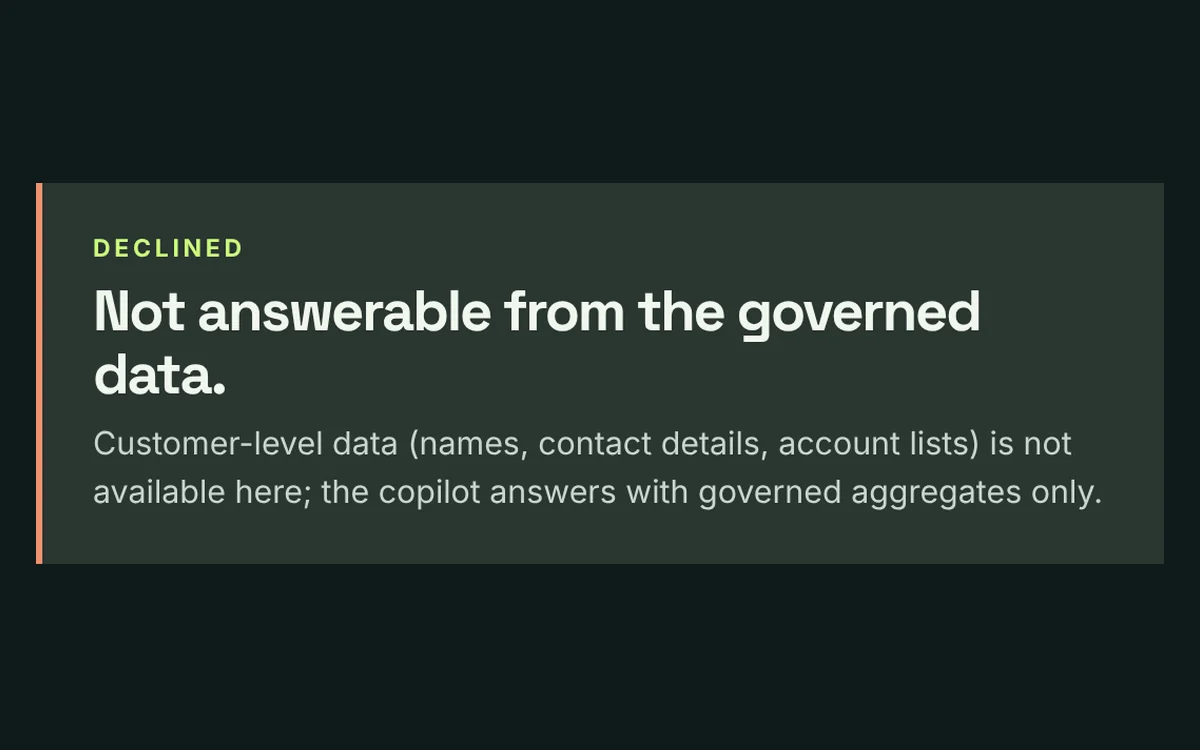 03
Decline
What if it cannot answer?
Unknown metrics, unknown breakdowns and personal data are declined, never guessed.
Open this stage
03
Decline
What if it cannot answer?
Unknown metrics, unknown breakdowns and personal data are declined, never guessed.
Open this stage
-
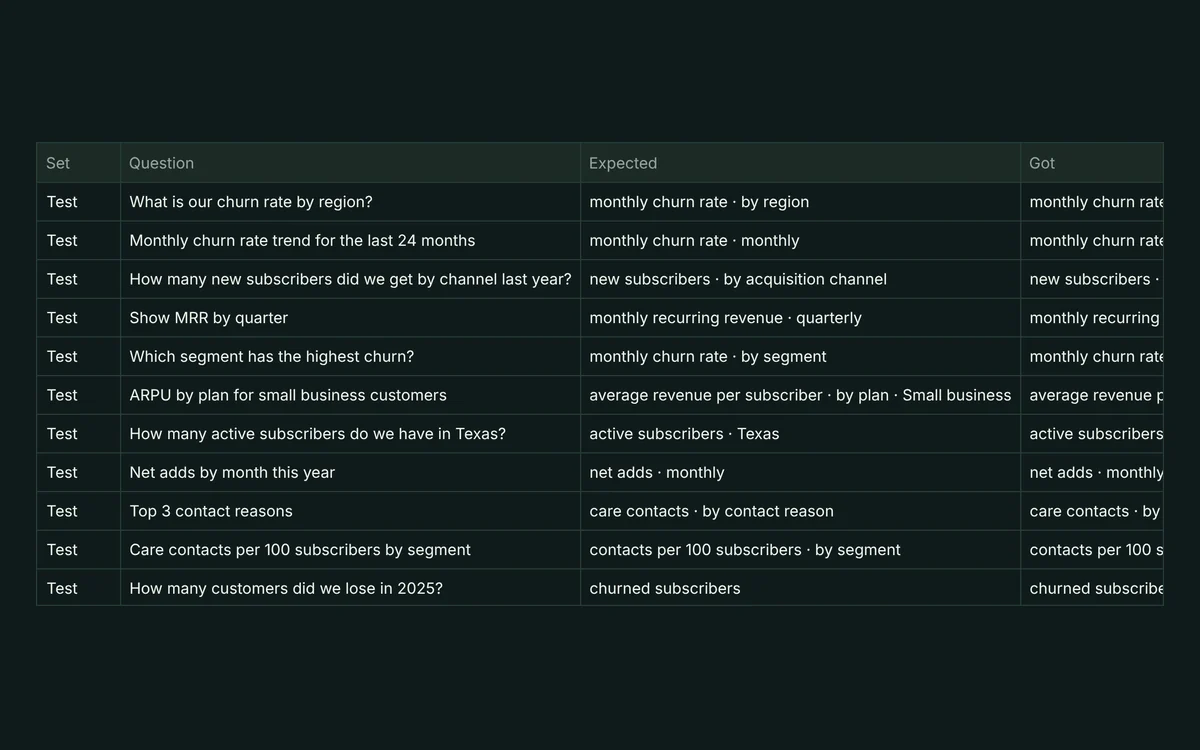 04
Evaluate
How often is it right?
A test set and a held-out set; the first held-out run caught a silent failure.
Open this stage
04
Evaluate
How often is it right?
A test set and a held-out set; the first held-out run caught a silent failure.
Open this stage
-
 05
Govern
What keeps it safe?
Read-only aggregates, compiled SQL, every answer logged and replayable.
Open this stage
05
Govern
What keeps it safe?
Read-only aggregates, compiled SQL, every answer logged and replayable.
Open this stage
03 / Under the hood
How it’s built.
Algorithms
- Semantic layer
- Rule-based intent parser
- SQL compiler
- Claude (optional)
- Evaluation set
Stack
- Python
- SQLite
- Semantic layer
- Rule-based parser
- Claude (optional)
- Streamlit
Methods, in order
- Semantic layer
- Intent parsing
- Compiled SQL
- Refusals
- Evaluation set
- Claude (optional)
Data
A synthetic subscriber warehouse: monthly subscriptions, care contacts and a month dimension.
04 / Outcomes
What it changed.
- 01
Every one of the 25 test questions mapped to the exact metric, filters and breakdown.
- 02
11 of 12 unseen phrasings right on the first held-out run; the miss exposed a silent failure, now fixed.
- 03
Unknown metrics, unknown breakdowns and customer-level requests declined, never guessed.
Results come from synthetic or public data with known answers. They show the method, not a client result.
05 / Try it
The live demo.
The real app, running on synthetic data. Change the inputs and watch the decision move.
Interactive, synthetic data. If nobody has used it for a while it takes about 30 seconds to wake.
Open in a new tab ↗06 / Related
Keep exploring.
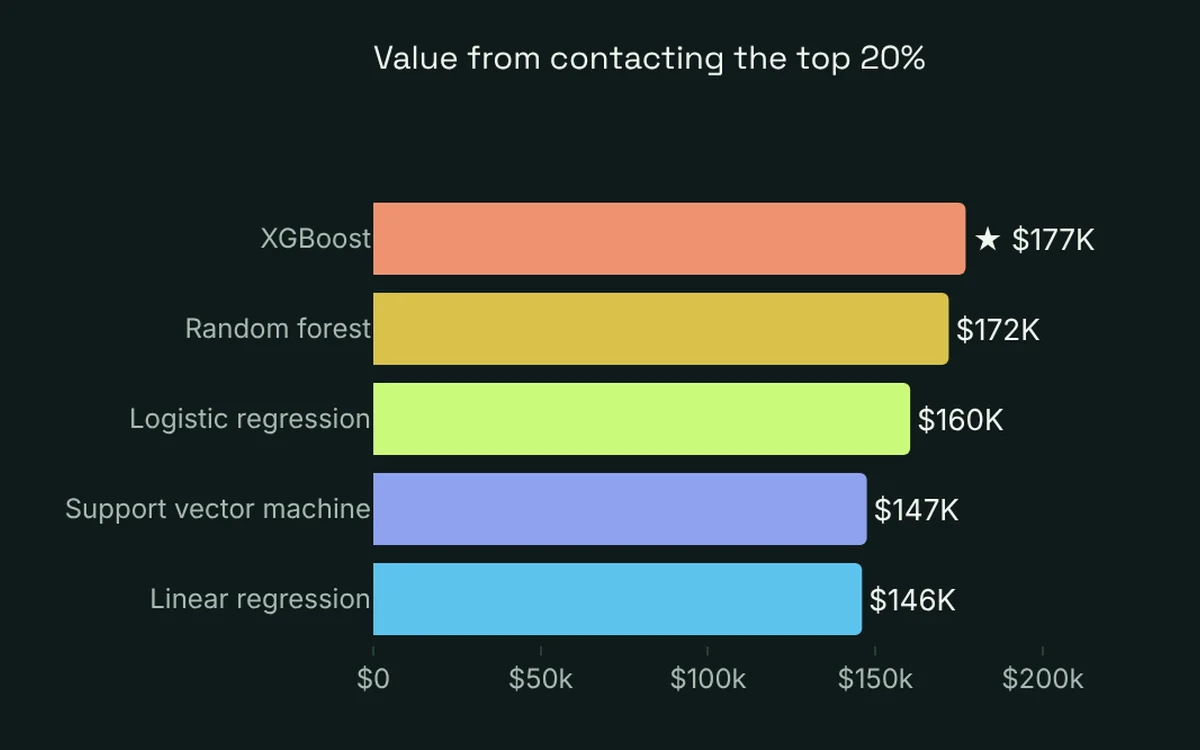 Interactive lab / 02
Subscriber value lab
A fictional internet and mobile provider with 60,000 subscribers: who will leave, who an offer actually saves, and how far prices can rise.
View project
Interactive lab / 02
Subscriber value lab
A fictional internet and mobile provider with 60,000 subscribers: who will leave, who an offer actually saves, and how far prices can rise.
View project
 Applied AI / 04
Credit policy assistant
Answers from a lending policy manual with every claim cited, and weak matches declined instead of guessed.
View project
Applied AI / 04
Credit policy assistant
Answers from a lending policy manual with every claim cited, and weak matches declined instead of guessed.
View project
 Data & decisions / 05
Causal impact lab
Two programs that were never randomized. The naive read gets the sign wrong; three causal methods recover the true effect.
View project
Data & decisions / 05
Causal impact lab
Two programs that were never randomized. The naive read gets the sign wrong; three causal methods recover the true effect.
View project
Open conversations